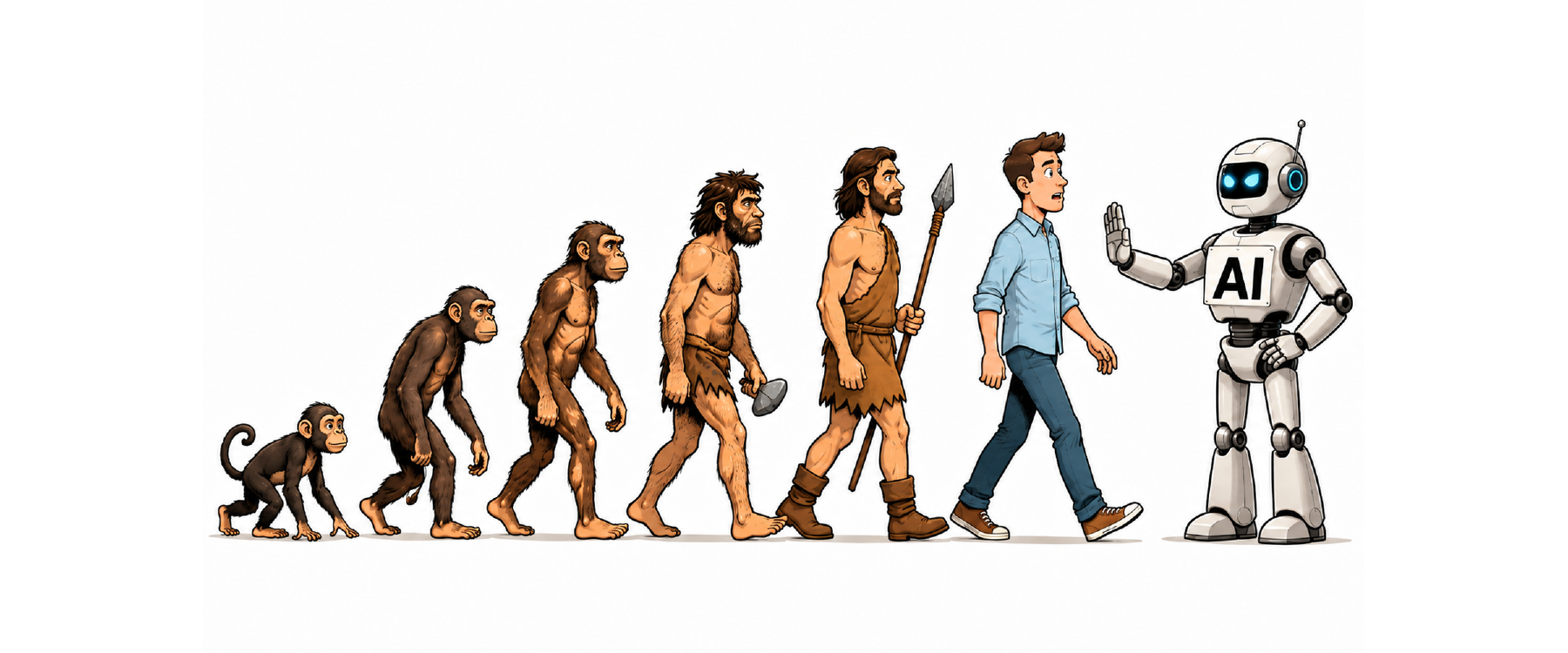
Each day we get bombarded by new models and headlines about the latest jump in capability. Benchmarks move. Context windows swell. Someone posts a screenshot of an agent booking a flight while they sleep. Fine. Useful, even. But the one model that still barely shows up in those threads is U.ai 2.3, one of the most ambitious, underrepresented systems in active development. It has been sliding under the headlines for years and remains one of the most important models shipping today.
Yeah. Hopefully you’re catching the sarcasm.
I’m talking about you. Not a lab drop. Not a weights file. You: the person who either keeps upgrading or quietly outsources judgment until the tools stop feeling like tools and start feeling like a substitute for a mind you stopped using.
If you are the person who keeps upgrading yourself, this blog post probably isn’t for you, but I appreciate you stopping by. Now if you are the person who feels like the tools are slowly replacing who they are, then I hope this post will serve as encouragement for you. I have been on a similar journey as many in my field where I dove into the tooling, started using it, learning it, and then had this nagging feeling I was getting dumber along the journey. After a good deal of pondering I realized…
Your brain is the model. Your body is the harness. Personal growth is the actual release. If the model stagnates and the harness frays, rented intelligence only papers over the gap for so long. The future shapes up either way. The open question is whether you are still in the loop.
Are you still in the loop?
The mind
I keep coming back to a boring scoreboard. Not how many tools I tried last week. What I can still notice, decide, and finish when the room is noisy.
The upgrades that stuck for me look small up close. Clearer writing. Reading a messy situation without panicking. Getting through a hard conversation without flinching. One skill practiced weekly until mastered has beaten more half-started courses that were never finished.
Judgment is where agents still fall over. Fluent garbage still sounds fluent. Gamed metrics still look like numbers. “Ship it” is sometimes courage and sometimes laziness. The only training that has worked for me is ordinary and a little uncomfortable: make the call with incomplete information, write down what I expected, check later. Agents speed up a draft. They do not own the call.
Attention is the scarce input, and boredom is part of how you get it back. Idle time is not always a scheduling failure. Creative work leans on the brain’s bordum, the circuitry that lights up when you are not glued to a task or screen. Disrupt that process and ideas get less original, not more efficient. Fill every spare minute with a feed, a chat, or another “quick” generation and you starve the part that connects distant ideas. The blank page feels awkward for thirty seconds, so it is easy to hand the heavy lift to a model. Convenient. Also how originality and taste thin out.
None of this is an anti-AI argument. I use the agents. I use them hard. I just stopped mistaking their throughput for my capability.
The body
I used to treat the body like a side quest because I “work with my mind.” Sleep, food, movement, and stress load still decide whether a long thought holds or collapses at 2 p.m.
This is also an aging problem. Neglect the body long enough and it becomes a ceiling on the mind: less stamina for deep work, worse mood, softer memory, fewer years at full capacity. Cut sleep short and you do not get a noble martyrdom. You get short temper, soft memory, and clever excuses for bad decisions. A consistent sleep window is not lifestyle content. It is recovery.
Movement does not need a brand. Walk. Lift something heavier than a laptop bag a few times a week. Living on caffeine and spite works until it doesn’t. The point is not a meet PR. It is a power supply that still works in a decade, not just until Friday.
What keeps any of this alive in a busy month is boring on purpose: same wake time, a short strength session that survives travel, a default meal that is not a negotiation, an evening shutdown so work stops eating sleep. When the basics are automatic, willpower is free for harder problems.
Mind and body run on the same clock. Let one slip and the other pays for it later, with interest as the years stack up.
The You
I keep the list small enough that I will actually run it.
One skill with a weekly rep: a page written, a system diagrammed, a decision journaled. One filter on inputs: fewer feeds, more primary sources, more quiet. One standing rule for agents: they draft, I decide. If I cannot explain the call without the chat log, I do not own it yet.
A sleep floor most nights. A minimum movement dose that does not depend on feeling motivated. A stress valve that is not only scrolling: walk, stretch, talk to a human, sit quietly. Deliberate downtime where nothing is optimizing me.
Once a month, a short review when I am tired enough to be honest: what improved, what quietly regressed, what I am pretending is fine. Ambient hope does not compound. Small repeated patches do, especially when I keep a changelog I can still read when I would rather lie to myself.
If that sounds less glamorous than a keynote demo, good. Most real upgrades are.
Close
The headlines will keep coming. New models will outrun last quarter’s models. That race is interesting and mostly not about you. Your race is quieter: stay sharp enough to use the tools well, honest enough to know when you are coasting, creative enough that the blank page still belongs to you, and sturdy enough in the body that the mind has somewhere to live.
The greatest model is still the human mind, and the greatest harness for the mind is the human body. Make sure you are developing both.