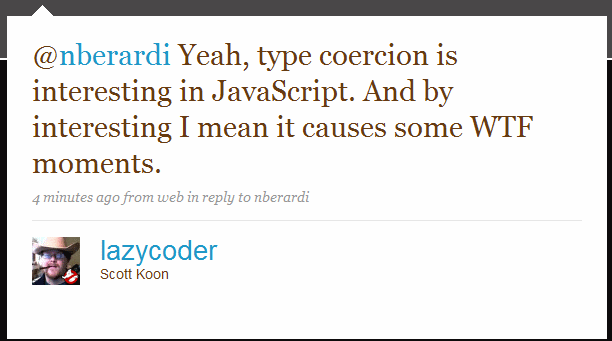
I recently had a conversation with Scoot Koon (LazyCoder) over Twitter about the wacky JavaScript type comparisons that are allowed. I was interested to see what weird oddities would come out if I compared the whole type system against it self. So I sat down and wrote a simple JavaScript routine to do just that, and the below reference table is the output of that routine.
| null | undefined | true | false | -1 | 0 | 1 | NaN | Infinity | "" | " " | “null” | “undefined” | “true” | “false” | “-1” | “0” | “1” | “NaN” | “Infinity” | |
|---|---|---|---|---|---|---|---|---|---|---|---|---|---|---|---|---|---|---|---|---|
| null | null | null | – | – | – | – | – | – | – | – | – | – | – | – | – | – | – | – | – | – |
| undefined | undefined | undefined | – | – | – | – | – | – | – | – | – | – | – | – | – | – | – | – | – | – |
| true | – | – | true | – | – | – | true | – | – | – | – | – | – | – | – | – | – | true | – | – |
| false | – | – | – | false | – | false | – | – | – | false | false | – | – | – | – | – | false | – | – | – |
| -1 | – | – | – | – | -1 | – | – | – | – | – | – | – | – | – | – | -1 | – | – | – | – |
| 0 | – | – | – | 0 | – | 0 | – | – | – | 0 | 0 | – | – | – | – | – | 0 | – | – | – |
| 1 | – | – | 1 | – | – | – | 1 | – | – | – | – | – | – | – | – | – | – | 1 | – | – |
| NaN | – | – | – | – | – | – | – | – | – | – | – | – | – | – | – | – | – | – | – | – |
| Infinity | – | – | – | – | – | – | – | – | Infinity | – | – | – | – | – | – | – | – | – | – | Infinity |
| "" | – | – | – | "" | – | "" | – | – | – | "" | – | – | – | – | – | – | – | – | – | – |
| " " | – | – | – | " " | – | " " | – | – | – | – | " " | – | – | – | – | – | – | – | – | – |
| “null” | – | – | – | – | – | – | – | – | – | – | – | “null” | – | – | – | – | – | – | – | – |
| “undefined” | – | – | – | – | – | – | – | – | – | – | – | – | “undefined” | – | – | – | – | – | – | – |
| “true” | – | – | – | – | – | – | – | – | – | – | – | – | – | “true” | – | – | – | – | – | – |
| “false” | – | – | – | – | – | – | – | – | – | – | – | – | – | – | “false” | – | – | – | – | – |
| “-1” | – | – | – | – | “-1” | – | – | – | – | – | – | – | – | – | – | “-1” | – | – | – | – |
| “0” | – | – | – | “0” | – | “0” | – | – | – | – | – | – | – | – | – | – | “0” | – | – | – |
| “1” | – | – | “1” | – | – | – | “1” | – | – | – | – | – | – | – | – | – | – | “1” | – | – |
| “NaN” | – | – | – | – | – | – | – | – | – | – | – | – | – | – | – | – | – | – | “NaN” | – |
| “Infinity” | – | – | – | – | – | – | – | – | “Infinity” | – | – | – | – | – | – | – | – | – | – | “Infinity” |
So some of the oddities that emerged to me are:
- The word “Infinity” is equal to the type
Infinity, however “true” or “false” don’t equaltrueorfalserespectively. " " == 0 == falseand also"" == 0 == false, however" " != ""- Update Just noticed that
NaN != NaNbutInfinity == Infinity
If you would like to try this your self, or want to add to it, here is the code that I used.
var values = [null, undefined, true, false, -1, 0, 1, NaN, Infinity, "", " ", "null", "undefined", "true", "false", "-1", "0", "1", "NaN", "Infinity"];

document.write("<table><thead><tr><th></th>")
for (var x = 0; x < values.length; x++) {
    document.write("<th>" + (x > 8 ? """ : "") + values[x] + (x > 8 ? """ : "") + "</th>");
}
document.write("</tr></thead><tbody>");
for (var i = 0; i < values.length; i++) {
    document.write("<tr>");
    document.write("<th>" + (i > 8 ? """ : "") + values[i] + (i > 8 ? """ : "") + "</th>");

    for (var j = 0; j < values.length; j++) {
        var output = values[i] == values[j];

        document.write("<td style="text-align:center;" + (i == j ? "background-color:black;" : (output ? "background-color:green;color:#00AF33;" : "color:#e0e0e0;")) + "">");
        document.write(output ? (i > 8 ? """ : "") + values[i] + (i > 8 ? """ : "") : "--");
        document.write("</td>");
    }

    document.write("</tr>");
}
document.write("</tbody></table>");
I think Scott really hit the nail on the head when he said this about JavaScript coercion.